🆕 HollaEx® v2.21 -- Valletta
HollaEx v2.21 Valletta brings official account statements, easier sign-ins and one of our broadest security rounds yet.



Most exchange break-ins aren't movie hacks. Nobody in a hoodie cracks the matching engine in 90 seconds. What actually happens is duller: an operator reused a password, a former contractor still had access, a bot tried a few million leaked logins, and nobody saw the alert until Monday.
The good news is that dull problems have dull fixes. If you run a HollaEx exchange, most of those fixes are already built into your admin panel. Your job is to switch them on, tune them to your risk and give your team a few habits to go with them.
This post covers the basics every exchange should have, why HollaEx's approach is built on almost 8 years of running real exchanges, and the habits that make it all work.
Key Takeaways
• Exchange security is layers, not a single wall. If one layer fails, the next is still there.
• Three layers every exchange needs: login history to see who tried to get in, active sessions to see who is in right now, and account controls to act on it.
• HollaEx has many more layers than we talk about in public. Operators find them in their admin panel.
• +8 years of running exchanges across many countries, operators and users shaped how HollaEx defends itself.
• Open-source roots mean the code has been tested in the open, a kind of hardening closed platforms never get.
• Real people with real exchange experience are there to advise and guide you, not just a ticket queue or a chatbot.
No single setting keeps an exchange safe. Layers do. Each one slows an attacker down, makes noise or limits what one mistake can cost.
No two HollaEx exchanges are set up the same way, either. Every operator tunes their exchange to their own market and risk, so what works against one tells an attacker very little about the next.
At any moment, you should be able to answer three questions: who tried to get in, who is in right now, and what you can do about it. Here's how that looks on HollaEx.
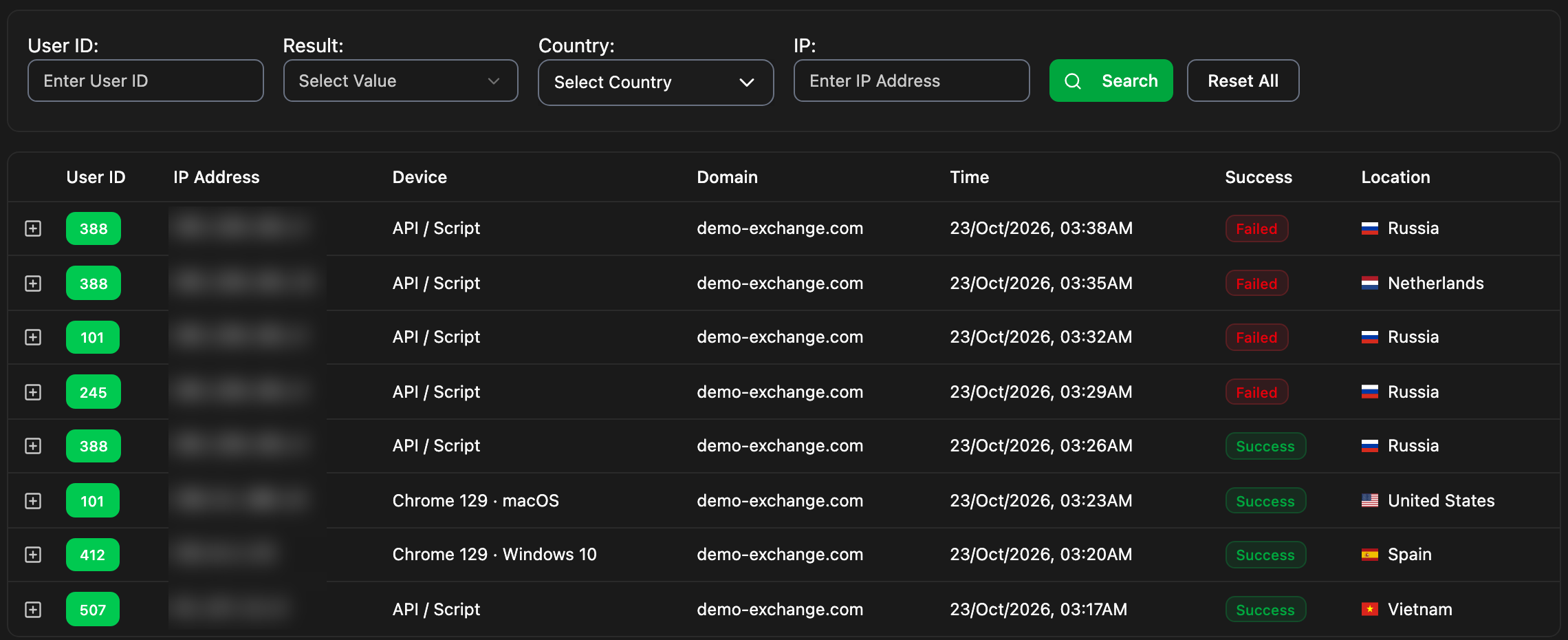
Every login attempt, successful or not, is recorded with its device, location and result. A burst of failed, scripted logins stands out at a glance, and so does a successful login from somewhere it shouldn't be. Even a slow, quiet attack leaves a trail.
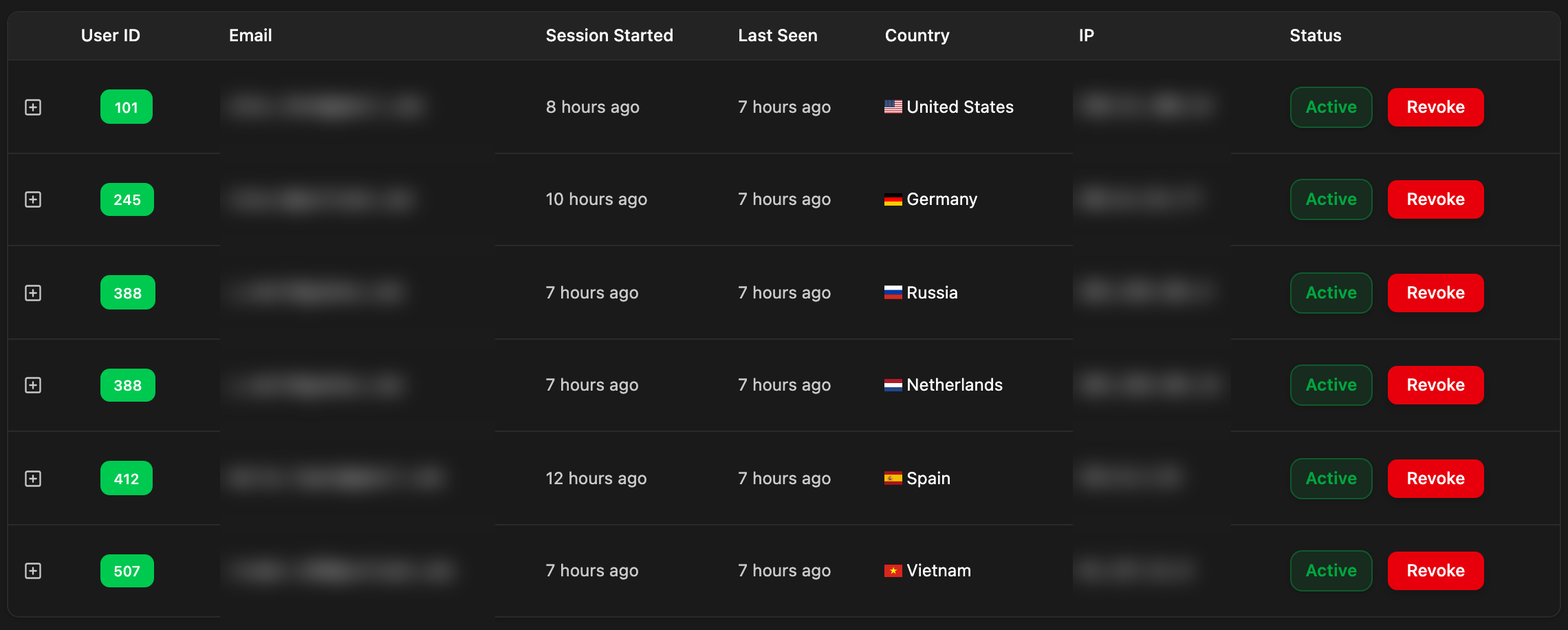
Spotting an attack is only half the job. You also need to know who is actually signed in. Active sessions show every live session with its device and browser, and any one of them can be signed out in a click. If a session looks wrong, end it first and ask questions after.
Not every problem calls for the same response. Account controls let you match your reaction to how sure you are that something is wrong:

These are the basics, and any serious exchange should have them. HollaEx has many more layers beyond these, and we keep them out of public posts on purpose. A published map of your defenses only helps the people attacking them. Operators find the full picture in their admin panel, along with a built-in check that shows which protections are actually switched on.
HollaEx has been in this industry for over 8 year, coming on 9. Very few white-label exchange providers can say that.
In that time, we've helped launch and run exchanges in many countries, for very different businesses and their users. Each market brought its own rules, its own user habits and its own kind of people trying to get in. Every attempt, edge case and unusual support ticket taught us something, and those lessons went straight back into the software.
That's how a robust system gets built. Not in a lab, but by running real exchanges for real users, year after year.
When we learn something running one exchange, it becomes an improvement for every HollaEx operator. Security work ships in our regular releases, so you don't have to discover every new trick the hard way. You get the benefit of what we've seen across every market we work in.
HollaEx started as open-source software. Its code was out in the open, where developers, security researchers and, yes, attackers could all take a look. Whatever they found got fixed, and the software got harder to break.
Most white-label platforms have never been through that. Their code has only ever been seen by the people who wrote it. You don't know what you don't know, especially if you've closed yourself off from the heat. Our open-source origin gave HollaEx a battle-tested layer of hardening that's very hard to get any other way.
All that operational knowledge is why HollaEx can be user-friendly and secure at the same time. We know which settings matter, which ones frustrate real users, and how to balance the two.
It's also available to you. If you want a second opinion on your setup, help tightening things up, or advice during a stressful moment, you can talk to real people who have run exchanges before. We'll recommend what fits your market and your risk, and guide you through it.
AI tools are useful, and we use them too. But when your exchange is on the line, nothing beats talking to a person who has seen it before and can tell you what to do next.
Software handles a lot. People handle the rest. These habits apply to any exchange:
Read about our most secure update yet v2.21. Exchange security isn't one feature. It starts with the basics: knowing who tried to get in, knowing who is in right now, and being able to act fast. HollaEx operators get those and much more, built on almost 8 years of running exchanges, a codebase hardened in the open and a team that has seen it before.
The rest is habit, and having someone experienced to call when you need them. Do both, and your exchange becomes a much less attractive target than the next one.
Running a HollaEx exchange? Every paying operator gets the Exchange Attack Response Guide, a step-by-step playbook for hardening your setup and responding when something goes wrong. We share it directly with operators only, so if a copy reaches you any other way, or arrives when you didn't ask for it, check with the HollaEx team before opening it. Want an expert to look over your setup, or thinking about launching your own exchange? Talk to the HollaEx® team.